

Education and Outreach
Mark Beattie-Edwards
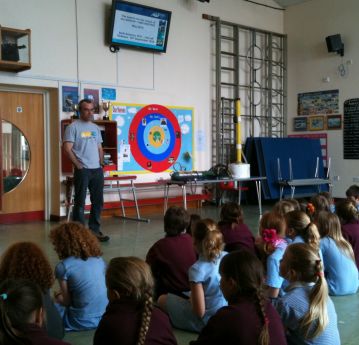
Team presentation at Padstow School
An ideal international education project for children
From the beginning the project has tried to have an international educational effort comprised of a confederation of schools in Canada, the United Kingdom and the United States.
The vessel at the heart of the project, the Baltimore pilot schooner Arrow, is unique in that she was constructed in the United States. The schooner Arrow was captured by Great Britain and put into Royal Navy service as HMS Whiting. The schooner HMS Whiting served in American and Canadian waters during the War of 1812. After the war, HMS Whiting came to grief on Doom Bar on the southwest coast of England, in 1816.
The project has a definite research and learning element, with schools researching how Arrow / HMS Whiting played a role in their local history before, during, or after the War of 1812 (Napoleonic War).
It is hoped that in time via a video teleconferencing link the participating schools will observe the activities associated with the project including the nautical archaeological survey of the wreck of HMS Whiting by ProMare and the Nautical Archaeological Society.
Participating Schools so far:
- St. Marys Elementary School, St. Marys (Camden County) Georgia, USA
- Mary Lee Clark Elementary School, St. Marys (Camden County) Georgia, USA
- St Michaels Elementary School, St Michaels, (Talbot County) Maryland, USA
- Padstow School, Padstow, Cornwall, England
If your school is interested in being involved please feel free to contact us
Project Areas of Study
1. St. Michael's Elementary School will research Thomas Kemp, the construction of the schooner Arrow, her maiden voyage in the Wine Trade, and subsequent capture by HMS Andromache (1811 - 18 May 1812)
2. St. Marys Elementary School and Mary Lee Clark Elementary school will research the wartime career of HMS Whiting in Royal Navy service on the Georgia coast (June 1814 - March 1815)
3. Padstow School will research the postwar career of HMS Whiting (July 1815 - September 1816) including her mission to interdict smuggling between France and Great Britain as well as the events surrounding HMS Whiting loss.
During the search for HMS Whiting carried out in May 2010 the team recorded their efforts and made short films. This films were uploaded onto www.teachertube.com so that students at the participating schools could keep up with the project's progress.
On the 20th May 2010 the team were invited to Padstow School by headmaster Phil Banks, to give an assembly to the children about archaeology and about the HMS Whiting Project. This 40 minute assembly was also recorded and uploaded to TeacherTube for all to see.
Diorama
Michael Higgins
HMS Whiting transported a contingent of Royal Marines from Bermuda to Cumberland Island for the invasion of Georgia. A team led by Michael Higgins constructed a diorama of that battle and presented it to the National Park Service Cumberland Island Museum, in St Marys.
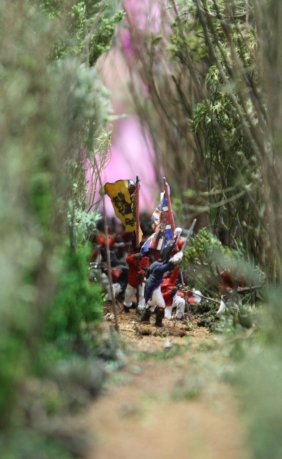
Photo 2
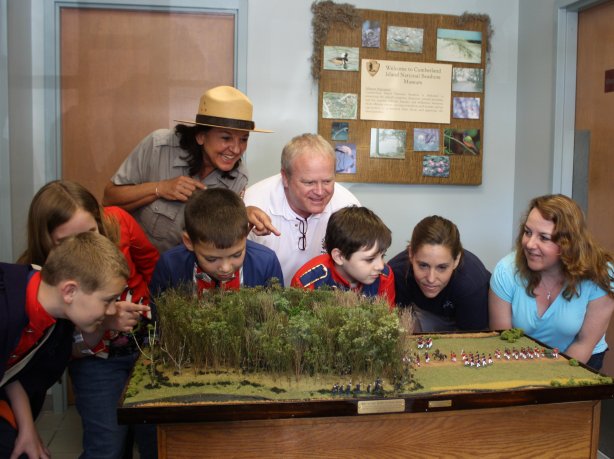
Photo 1
Photo 1 - Left to Right: Ginger Hollingsworth-Cox, park ranger; Michael Higgins, Camden County War of 1812 Historical Commission; Mary Boily (Mary Lee Clark Elementary School) and Elisabeth Moody (St Marys Elementary School), and some of the students.
Photo 2 - Diorama close-up photo British troops on the road marching to Battery Point Peter while the American troops wait in ambush.
