Not Set
‘Never was a vessel lost with greater recklessness’. The paddle steamer Ajax wrecked on the Mewstone Ledge in broad daylight in fine weather.
Type
Paddle steamship
History
Wednesday, 28th January 1843 saw the launch of two new steamships at the shipyard of Vernon & Co. in Liverpool; the Windsor was to sail between Liverpool and Belfast, and the Ajax was for the London and Cork route. Ajax was propelled by two side paddle wheels driven by a 400 hp steam engine, and she also had three masts so she could carry sails in case the steam engine failed. This was old technology; in nearby yards, the new vessels were being fitted with the much more effective screw propeller. Even so, Ajax was the fastest steamer operated by the Cork Steamship Company; she could transport over 300 passengers and finish the journey in less than 30 hours, making her a very popular vessel.
.jpg)
Drawing of Ajax, click the image for a larger version
On Thursday, 12th October 1854, the Ajax departed Gravesend for Cork with 31 crew and 350 passengers on her final voyage. Captain Tooker, her regular master, was taken ill, and he was replaced by Captain Rochford. Rochford was the skipper who had wrecked the steamer Minerva off the Skerries only 3 months before. Sixty passengers were government emigrants for Sydney, Australia, who were being brought to the Plymouth depot for embarkation in the ship Samuel Boddington, ten soldiers belonging to various regiments, some recruits, and one gentleman, a youth, and a German lady as cabin passengers. All the rest were Irish labourers heading for Cork, with more than three-quarters of them being women and children. The cargo was mainly destined for Cork with oil, beer and drapery for Plymouth.
The weather was fine and clear as the Ajax made her way down the English Channel, perfect weather for sailing. The steamship approached the entrance to Plymouth Sound on Friday, 13th October, and was making between eight and nine knots on flat seas, forging away with her accustomed power. Captain Rochford had just finished dinner and had been on watch on the bridge for about half an hour. The second mate noticed that the ship was steaming closer to the Devon shore than he thought safe, and sufficient distance had not been given to avoid the Mewstone. The mate informed the captain that he thought they were too close inshore, but Rochford responded with a rebuke, asking if ‘he did not know how to navigate the English Channel?’. Almost immediately after, the ship drove upon the Mewstone Ledge that lies 150 yards off the southwest corner of the Mewstone, she struck a pointed rock, tearing a hole in her iron hull and flooding the forward compartment. The captain ordered the Chief Engineer to reverse the steam engines, but the engineer refused to do so, because there was more than four feet of water in the hold, and reversing would have caused the ship to sink in deep water. The crew of the Ajax sent a distress signal, which was seen by lookouts on the 81-gun warship Calcutta moored inside Plymouth Sound. The message was passed to ships in the area, including H.M. paddle steam-tug Confiance, the steamer Paddler, the steamship City of Limerick, and the hired steam tug Queen also left to assist.
There was chaos on board the Ajax because the passengers panicked when they realised that the ship was aground. A fight took place between a passenger and one of the crew, so the first mate jumped off the paddle box, seized the passenger by the collar and hauled him to the other side of the ship. With the Mewstone so close by and no vessels yet in sight, it was decided to get the passengers off the ship using the ship’s boats under the direction of Chief Officer Mr Steele. After the ship's four boats were launched, the passengers were so eager to leave that they jumped into and nearly sank two of them. The chief officer then armed himself with a stick, took charge and allowed only a safe number of passengers to board. About 30 passengers were conveyed to the Mewstone before help arrived.
The tug Confiance arrived on the scene and started to take off the passengers, and she was soon joined by the billyboy (East coast sailing barge) Pirate of Goole, returning from Dunkirk, whose master, Mr W. Watson, stopped the vessel to aid in the rescue. Captain Rochford was one of the first to prepare to leave the ship and get onto the Mewstone, but was prevented by the lifeboat filling with water, but he sent for his life buoy and was ready to go when the Confiance steamer arrived. Some of the passengers managed to rescue their luggage, but most others were not so lucky and only had whatever clothes they stood up in. It was fortunate that the wrecking happened in daylight and in good weather; had the accident occurred later in the day, many people may have lost their lives.
The chaos continued when the rescued passengers were delivered to Millbay Pier. On arrival, two women were found to be prematurely in labour, and both delivered their newborns in the small Pier Master’s office. Straw was laid on the floor of an empty storeroom and was used as temporary accommodation for the passengers while they awaited their fate. A few days later, the Juverna arrived from Bristol and took away some of the passengers, and the emigrants made it to the Samuel Boddington bound for Melbourne, many without any clothes or luggage.
With the passengers safely evacuated, the crew remained alongside the Ajax in another steamship to await the next high tide because the Captain was certain that the Ajax could be floated. Mr Brown, master-attendant at the Dockyard, went out at midnight in the Confiance with two Government ‘lumps’, lifting barges, intending to lash one each side of the Ajax and float her off as the tide rose. But by the next morning, the ship had settled deeper into the water, and all efforts to pull the Ajax off the rocks had failed. By midday, she had split in two, so the vessel was declared a total loss. On the morning of Thursday, 19th, a diver went out to the wreck and found the afterpart of the vessel whole and sound, as well as the engines. The diver went down to the state cabin, but his air hose got tangled in the wreck, and he had to surface, bringing nothing with him. On Thursday night, it blew a gale from the southwest with heavy rain, bringing with it a heavy sea that continued to break up the ship’s hull. The sea opened the forehold, and the remaining cargo burst out, then sank to the seabed or floated away.
The Ajax cost £32,000 to build, and her cargo was valued at £10,000, and much of it was lost. Despite the calm wind conditions and fine weather, the Ajax was wrecked in broad daylight on a well-known hazard to shipping because of the negligence of Captain Rochford. Amazingly, Captain Rochford would later be cleared of blame at a board of inquiry and was later given command of another steamship!
The remains of the Ajax were a hazard to shipping and lay just below the water on the Mewstone Ledge, as initially no attempt was made to remove them. In a sad postscript to the accident, on the 1st March 1866, the fishing vessel James and Matilda was passing the Mewstone when she collided with one of the engines of the Ajax. She sank so fast that John Bunce and Matthew Phillips lost their lives, while the 19-year-old boy, William Bunce, survived by swimming to the Mewstone. On 22nd November 1871, the large fishing boat Dabb hit the remains of one of the Ajax’s paddles on the way to Torbay from Plymouth, the owner and skipper Francis Morley, mate Lappige and a lad named Stokes were drowned. In 1875, divers were finally engaged to break up the remains of the ship, and were removing sections weighing up to ten tons. The plan was to remove all of the wreck but this did not happen as some remains on the seabed.
This is a condensed version of the story. For more information, please contact The SHIPS Project.
Diving the Ajax
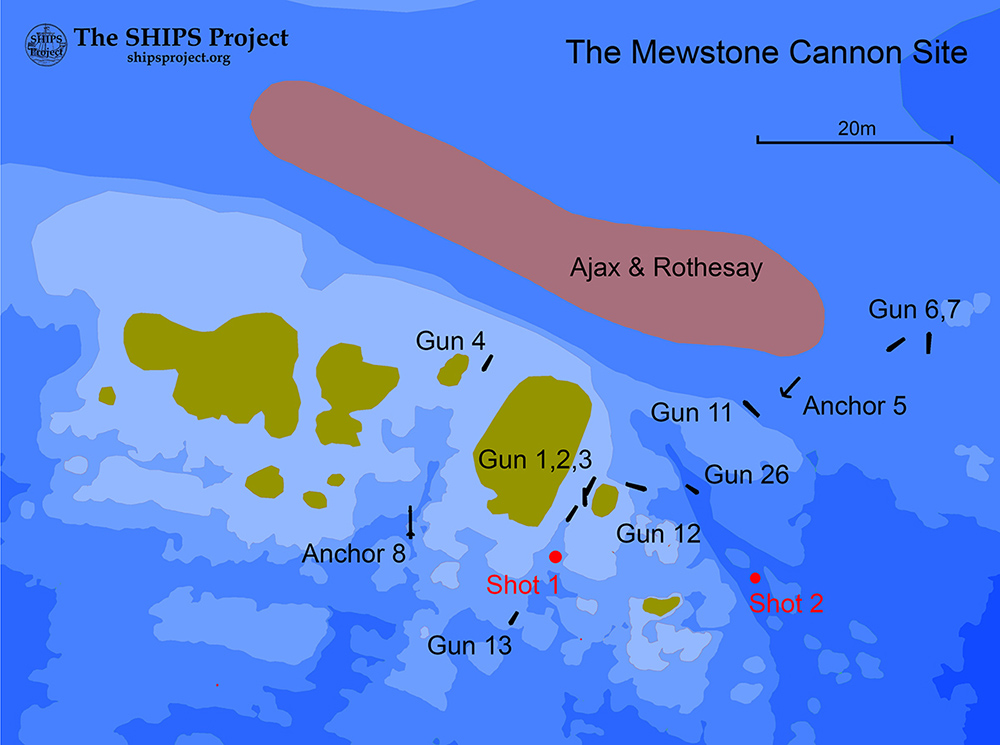
Site plan of the Ajax and the Mewstone Cannon Site by The SHIPS Project, click the image for a larger version
Mewstone Ledge, north side
The wreck lies on the north side of the Mewstone Ledge, scattered over an area more than 100m x 100m in depths from 5m to 15m. This is can be a beautiful site in calm, sunny weather but its best avoided if there is a swell, and the current can be severe especially on a spring flood tide. The bow of the Ajax is to the west, but the wreckage in the area may be from several ships so it is difficult to identify which part is which. The seabed is a rock reef topped with thick kelp, and the ironwork from the wrecks is partly covered with weed, so it's hard to tell wreckage from rocks. But if you get down onto the ‘seabed’ in this area you may start to see parallel lines of iron frames under the weed which are the remains of her bottom, her sternpost sticks up out of the seabed and you may also find her rudder nearby. The engines and her many brass fittings are gone as she was visited by salvors several times in her past. The stern of the Ajax which lies to the east overlaps the Mewstone cannon site so you can sometimes find bits of an 18th century armed merchant ship alongside fragments of iron hull.
Nearby wrecks include the Rothesay  , the Mewstone Cannon Site ,
Nepaul ,
Constance
and Glen Strathallan
, the Mewstone Cannon Site ,
Nepaul ,
Constance
and Glen Strathallan
Last updated 23 December 2025


Information
Date Built:
1846
Type:
Paddle Steamship
Builder:
Vernon & Co. Ltd., Liverpool, England
Official Number:
Unknown
Length
206.4ft
Beam
27.4 ft
Draft
Construction
Iron, carvel construction
Propulsion
Steam, 400 hp direct lever engine supplied by Berry, Coutis & Co. driving two paddle wheels
Tonnage
846GRT / 591NRT
Nationality
British
Crew
31
Master
Captain Rochford
Owners
Cork Steamship Company
Cargo
General
Portmarks
None
Date of Loss
13th October 1854
Manner of Loss
Wrecked
Outcome
Salvaged?, Abandoned
Reference
HOB UID 1527646
The Loss of the Minerva
Captain Rochford was master of the paddle steamer Minerva when she was wrecked in similar circumstances. Minerva was built in 1847, also by Thomas Vernon & Sons, Liverpool, for the Cork Steamship Co. On Tuesday, 29th August 1854, Minerva struck a reef known as the Victoria Rock near the Skerries, going at full speed. The rock ripped the hull open, and she filled with water. The Minerva then drifted off the rocks and sank by the stern, not before all the passengers and crew had been put safely into the boats.
Not Set
Leave a message
Your email address will not be published.
Click the images for a larger version
.jpg)
.jpg)
Image use policy
Our images can be used under a CC attribution non-commercial licence (unless stated otherwise).