
Barn Pool Excavation 2026: Back to the Trenches
Discover the hidden history beneath our feet!

For this exciting Community Archaeology Project, we invite people of all ages to get involved in real-life archaeology experiences, including training days, excavations and uncovering local history. Whether you are a history enthusiast or simply curious, this was a unique opportunity to engage with the past and learn new skills, all for FREE.
The 2026 excavation will run from 10th to 16th August at the Barn Pool beach, at Mount Edgcumbe  . This event is available for everyone and is inclusive and accessible for all.
The project is run by The SHIPS Project CIC and the archaeological director is Mallory Haas.
Sign Up for the Dig
Numbers are limited for this archaeology experience so you must pre-book.

The dig runs from 10-16th August, from 10am-5pm.
Location: Barn Pool, Mount Edgcumbe, Torpoint PL10 1HZ
What3Words: driven.body.trees
What We Found in 2025
.JPG)
The Barn Pool Dig was held at the Barn Pool beach at Mount Edgcumbe in Cornwall, between the 26th and 31st August 2025, with further work between 5th and 6th September. We held an open day on the site on 27th September, and the site was closed on 29th September. Permission for excavation at the Barn Pool was given by Mount Edgcumbe House, in coordination with Plymouth City Council and Cornwall Council.
The Barn Pool Dig 2025 was made possible through funding from Plymouth Sound National Marine Park (PSNMP), National Lottery Heritage Fund and the Mount Edgcumbe Estate. The dig was organised for The SHIPS Project by the Archaeological Director, Mallory Haas.
We did some geophysics over the site before the excavation started, and the trenches were placed over the most interesting areas that the geophysics detected. We also used aerial drone and LiDAR data to help decide where to excavate.
The geophysics data showed a buried linear feature which we excavated as Trench 2 and it turned out to be a section of brick wall, probably WWII date. Trench 3 was placed over a feature we could see on the LiDAR data and the resistivity map. Under the turf was a layer of soil, large stones and brick, with a layer of burnt material similar to one we found in Trench 2. Below this, the trench was filled with large tree roots and soil at a depth of 300mm. Any anomaly was likely to be beneath this layer, but this was not investigated as it would require the removal of several large roots from an established tree. We opened up other trenches that we used for teaching, and Trench 5 was excavated to help us understand the different soil layers. Trench 5 was placed at the lowest point on the site and in it we found evidence of the original beach surface, now covered in soil through land reclamation.
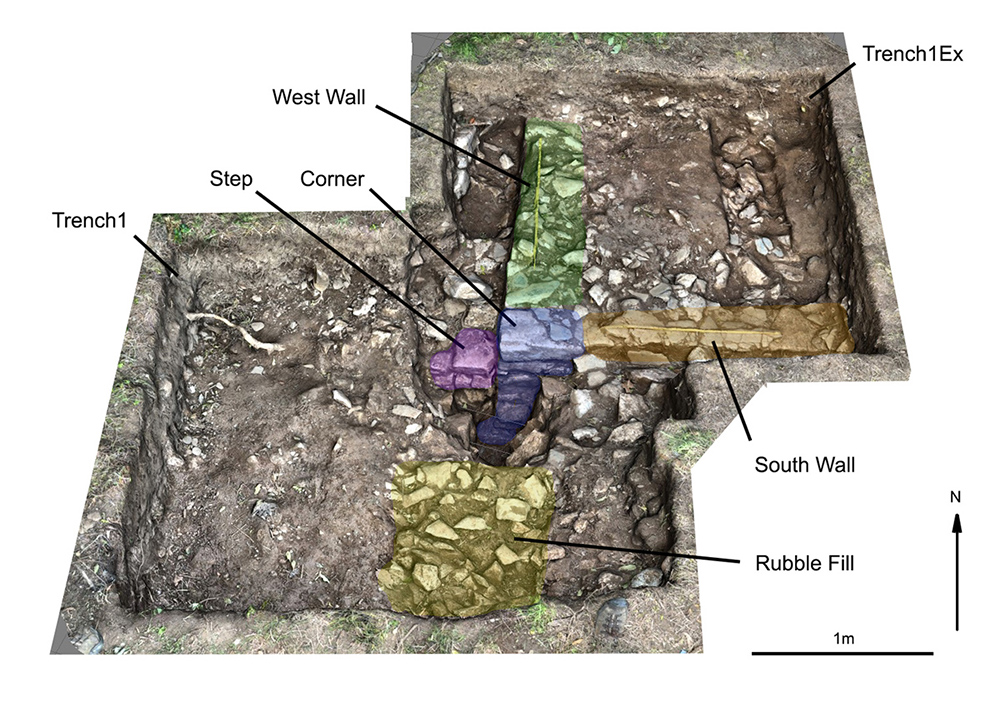
Trench 1 is where we found the remains of a building. The location for Trench 1 was selected based on geophysics, a long east-west anomaly extending 3m east and at least 6m west, about 2m wide. Trench 1 was opened on 26th August 2025 with the removal of the overlying turf. Just below the turf was a line of rubble and brick fill, with the correct alignment to be the cause of the geophysical anomaly. Excavating further, we came across a dense layer of limestone rubble, and in the northeast corner we found a rectangular limestone block lying flat on the ground. We investigated the block and discovered that it was sitting on top of another just like it, so perhaps we had found a stone pillar or maybe a wall. The trench was extended in size so we could carefully expose what we had found; the top block was sitting on top of a series of similar blocks that looked like the foundations of a wall. The line of the possible wall was followed to the east and the north and yes, we had discovered the corner of a building. The walls are constructed from rough-cut limestone blocks with slate in between as packing pieces, and there were remains of lime mortar between the blocks. To the west of Block A is a small horizontal ‘step’ feature which was only partly excavated. The upper step stone is set on top of three similar-sized squared blocks which appear to be lying on roughly shaped limestone blocks.
We held an open day on the site on 27th September to show the public the stone feature in Trench 1, and Trench 1 was closed on 29th September. The trench was reburied in a way that protects the site but allows us to uncover it with ease. The trench was laid over with geotextile and tarpaulins, then dumpy bags were laid on top and filled with spoil. The bags were then covered with topsoil and the turf replaced on top.
- A history of the Barn Pool
- Researching the Barn Pool story
Leave a message
Your email address will not be published.
Click the images for a larger version
s.jpg)

s.jpg)
s.jpg)
s.jpg)
Image use policy
Our images can be used under a CC attribution non-commercial licence (unless stated otherwise).