Not Set
The SS Persier was sunk by a torpedo in 1945 off the Eddystone, after having escaped from the Germans in France, being bombed in Oban, surviving a hurricane, wrecked in Iceland and turned into a blockship.
Type
Merchant steamship
History
The merchant steamship S.S. Persier began life in June 1918 as the War Buffalo, built in Newcastle by the Northumberland Ship Building Company. A 122m (400ft) long World War 1 British Standard Class B ship of 5228 tons. War Buffalo arrived just as the First World War ended. The ship remained in Government ownership, managed by Rankin Gilmour & Co., in Liverpool, and she made at least one trip across the Atlantic. War Buffalo was sold to Lloyd Royal Belge SA in 1919, where she was renamed Persier.
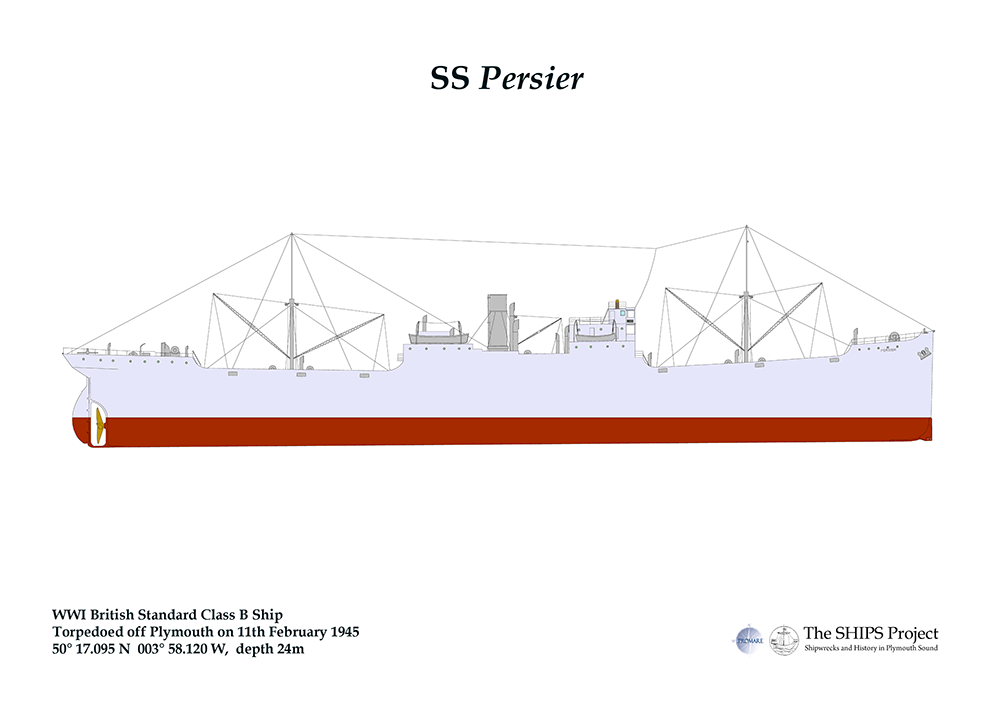
Drawing of the Persier by The SHIPS Project, click the image for a larger version
Persier did not take part in the Allied retreat from Dunkirk; instead, she was involved in the evacuation of Allied military forces and civilians from ports in western France, known as Operation Aerial. On 18 June 1940, Persier and her crew were in the harbour of La Rochelle on the west coast of France, but the German army was rapidly heading their way. A Belgian civil engineer called Hugo van Kuyck was also in La Rochelle; Persier’s captain was absent, so van Kuyck decided to take command. He took the ship and the fifty-two soldiers and six civilians on board and headed north to Milford Haven in Wales, escaping the Germans by just four days. Persier was later involved in convoy HX 84, which was attacked by the German heavy cruiser Admiral Scheer in November, and then was bombed and damaged by the Luftwaffe while anchored in Oban in December. On 12th February, she was travelling with Convoy HX 109 from Halifax to Liverpool when the ships were caught in a hurricane. Her master, Jacques Heusers, reported ‘chunks of ice torn from ropes, flying past our heads like cannonballs; fierce sea currents, gigantic waves, abyssal troughs’. The Persier was further damaged in the storm, so they tried to take shelter in Reykjavík in Iceland, but instead the ship ran hard aground on the shore just east of the edge of Hjörleifshöfðifjörður near Vik. The cargo of trucks on board was salvaged, rebuilt and sold to the islanders while the ship was emptied, patched up and towed back to the River Tyne, where she was repaired, close to the shipyard where she was built. It looked as though this ship would end her career in 1944 when she was chosen to be a blockship as part of the temporary Mulberry harbour constructed off Arromanches for the D-Day invasion of Normandy. She was taken to the Clyde and prepared; all usable fittings were taken off, openings cut in the watertight bulkheads, and hatch covers removed. At the last minute, she was granted a reprieve. Persier was taken to Cardiff to be temporarily repaired so she could travel to her home port of Antwerp in Belgium to be properly refitted.
Her final voyage began on the 8th February 1945, now patched up and safe to travel, leaving Cardiff with convoy BTC65 heading for Antwerp. Her master was E.S. Mathieu; she had a crew of 64 and a cargo of food and 2200 tons of soap. Also on board was the convoy Commodore Edmund Wood and three British signalmen. The ship was armed with five 20mm Oerlikon anti-aircraft guns and one 4in. gun on her stern, and she carried two British and five Belgian DEMS crews to man them.
The convoy was delayed by the weather and did not reach the Eddystone until the 11th February, with ships spread over 10 miles of sea, with Flower class corvette HMCS Algoma in the lead. Nearby was the type VIIC/41 U-Boat U-1017 under the command of Oberleutnant Riecken. At 5:20 pm, the wind was blowing westerly force 7 gusting 8, and the Persier was making 7 knots through big seas when the Commodore received a report that a periscope had been sighted. An explosion away from the convoy off to port was then thought to be a prematurely exploding torpedo. A second torpedo missed the stern of the Persier, but five minutes later, a third struck hold No. 2 on the port side. Persier started taking on water, and she quickly developed a list to port.
The ship remained afloat but appeared to be sinking. Darkness was coming on, the weather was bad, and all her lights had failed, so the captain and crew abandoned ship at 6;25pm. However, a faulty valve caused her steam engine to restart, turning the huge propeller, causing damage to two of her lifeboats that were now under her stern. The survivors were rescued by the ships Birker Force, HMS Cornelian and Gem, but twenty people were lost, including Commodore Wood. They lost sight of the abandoned Persier as she drifted downwind in the darkness. Rescue tugs searched for her, but she was not to be found.
The wreck was eventually located by Colin Hopkins and three others in May 1969 when they were diving on a snag reported by a friend who was a local fisherman. She was found intact but broken with her 4 in. gun on the stern and two machine guns on the bridge. In May 1970, her bell was recovered, carrying the name War Buffalo, confirming that this was the last resting place of the Persier. The wreck was bought for £300, and the guns, propeller, and much of the non-ferrous metal were salvaged.
Diving the Persier
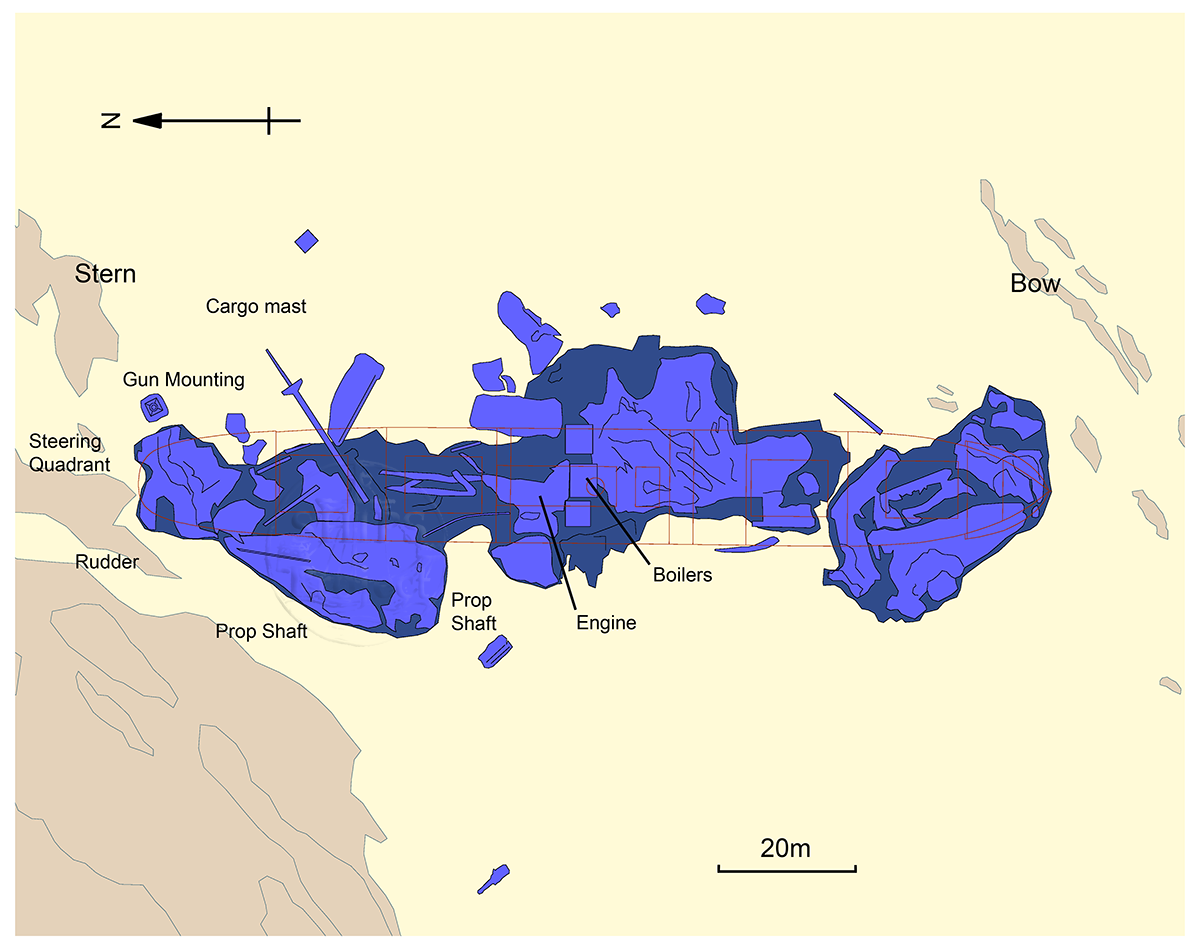
Site plan of the Persier by The SHIPS Project, click the image for a larger version
Located midway between Plymouth and Salcombe, the Persier can be dived at any state of the tide with only minimal current. The hull rests on the sand with her stern close by a reef to the north, with her shallowest part at 24 metres plus tide height. Try to drop the shot at her boilers, which stand proud of the seabed or at the stern. The coordinates are given below.
The wreck has collapsed to port with the bow pointing to the south, so the western side of the wreck is mainly hull plates, and the eastern side is mainly deck and upperworks. At the stern, the propeller has been salvaged, but the rudder and steering quadrant can still be seen. Schools of bib and pollack populate the wreck, and friendly crabs poke out from all areas. East of the quadrant is the box-like shape of the stern gun mount, now missing its salvaged gun. The aft cargo mast is easily recognisable lying at an angle across the wreck, alongside is a cargo winch and the remains of No. 3 hold. The propeller shaft tunnel used to be accessible but has now collapsed along its length, with the shaft still inside. Just to the north of the three huge boilers are all that remains of her collapsed engine, just the crankshaft, leading sternwards to the thrust bearing and propeller shaft. The three boilers have all been rolled over, so they now lie upside down. There are large areas of flat deck plates which are home to pink sea fans, a protected species, so swim carefully over them. Forward of the boilers is No. 2 cargo hold, now mostly empty, but the remains of the occasional wooden soap box can still be found, sometimes with the words ‘Sunlight Soap’ printed on the side. Between the holds is the forward mast with associated winches at the base, and nearby is the anchor windlass and the remains of the bow with its recognisable hawse holes for the anchor chains, rotated around so it points back along the wreck.
50° 17.091 N 003° 58.120 W Boiler shot location
50° 17.122 N 003° 58.133 W Stern shot location
Nearby wrecks include the Viking Princess  , the Marie , the Oregon and the Totnes Castle .
Last updated 4 April 2026


Information
Date Built:
1918
Type:
WW1 British Standard Class B steamship
Builder:
Northumberland Ship Building Company, Howdon on Tyne, Yard No. 248
Official Number:
142428 (1918)
23214 (1920)
81234 (1930)
31193 (1943)
Length
122m (400.2ft)
Beam
15.9m (52.3ft)
Draft
8.7m (28.5ft)
Construction
Steel, riveted, two decks
Propulsion
Steam, 517hp triple expansion direct acting vertical inverted, three boilers, oil fuel, North Eastern Marine Engineering Co., 1 screw
Tonnage
5228 GRT, 3227 Net
Nationality
Belgium
Crew
65
Master
Captain E.S. Mathieu
Owners
UK Government, Shipping Controller, managed by Rankin Gilmour & Co., Liverpool (26)
Compagnie Maritime Belge (Lloyd Royal) SA
Portmarks
None
Voyage
Milford Haven to Antwerp
Cargo
2200 tons soap, 6 tons electrical apparatus, one case of steel, 16 tons of leather, 5 tons woollen blankets, 9 tons baby food, 968 tons canned meat, 16 tons rationing stamps, 1186 tons dried eggs, 8 tons motor-car parts
Date of Loss
11th February 1945
Manner of Loss
Torpedoed
Outcome
Salvaged
Reference
HER MDV71237, UKHO 18119
British WW1 Type B Standard Cargo Ships
In December 1916, in view of the growing losses of British ships to combat, it was decided to begin an extensive shipbuilding program for the Government. The new ships were to be of a simple, standard type. The prefix to their names was to be WAR. After the Armistice in 1918, many ships under construction were sold and completed to their owners specifications. Excluding orders to United States shipyards, 821 vessels were ordered from U.K. yards and abroad. 416 were completed for the Government. 279 were sold and transferred to private owners before completion and the remainder were cancelled. During WW I, 14 were lost, but in WWII large numbers of these ships were lost.
Not Set
Leave a message
Your email address will not be published.
Click the images for a larger version
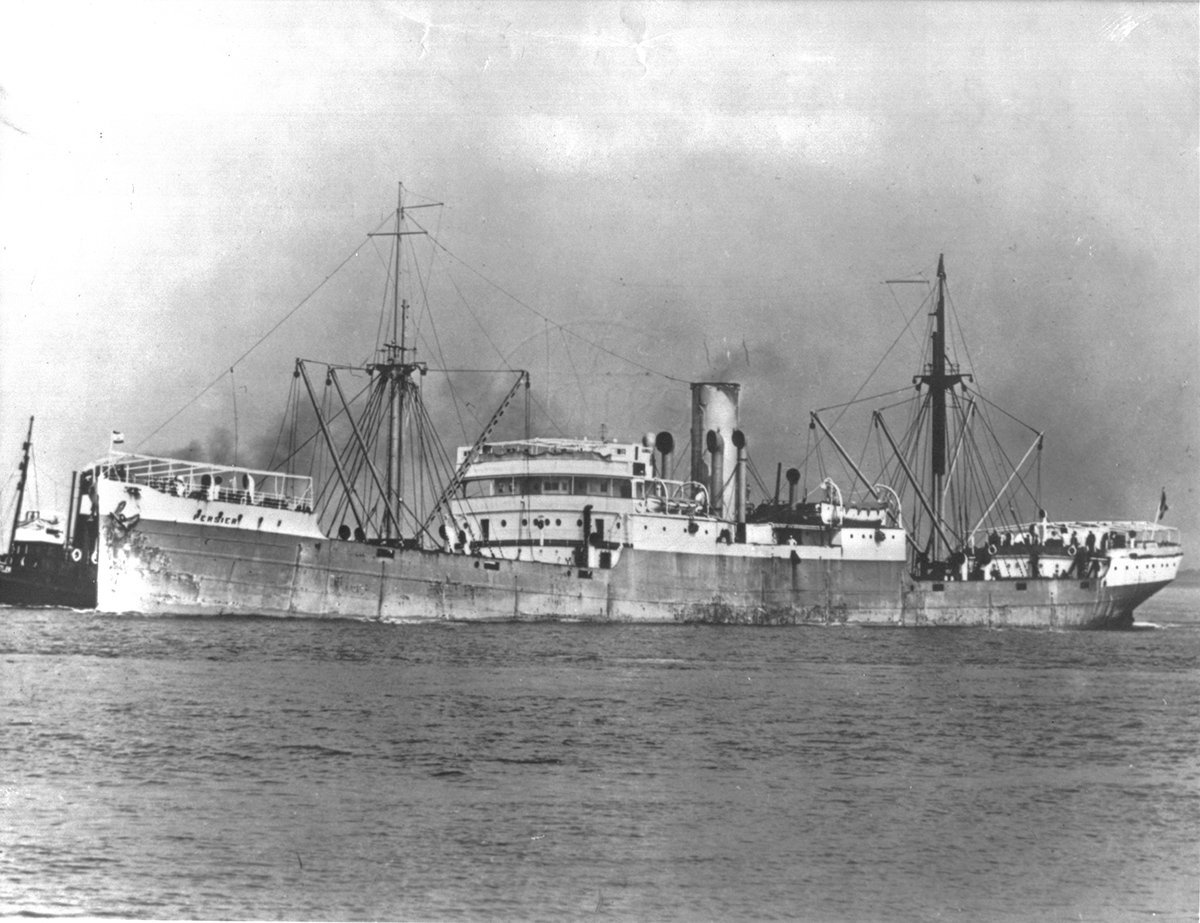
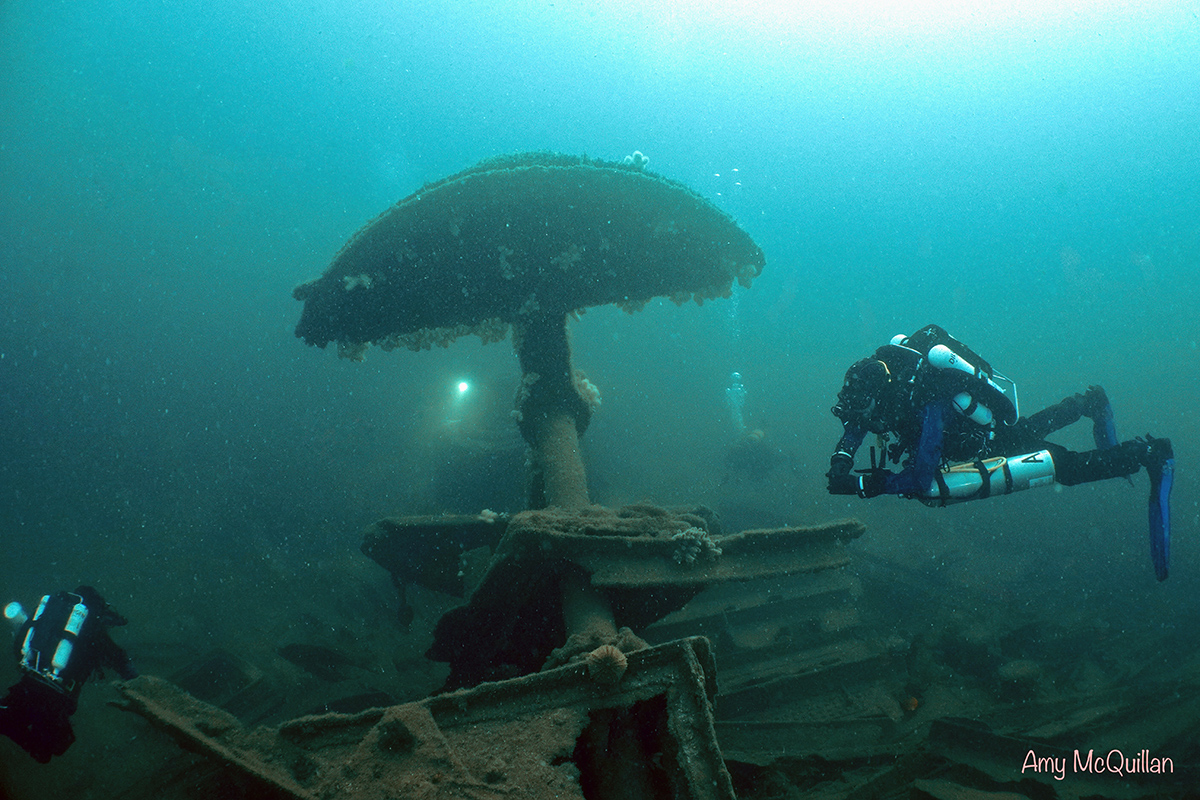
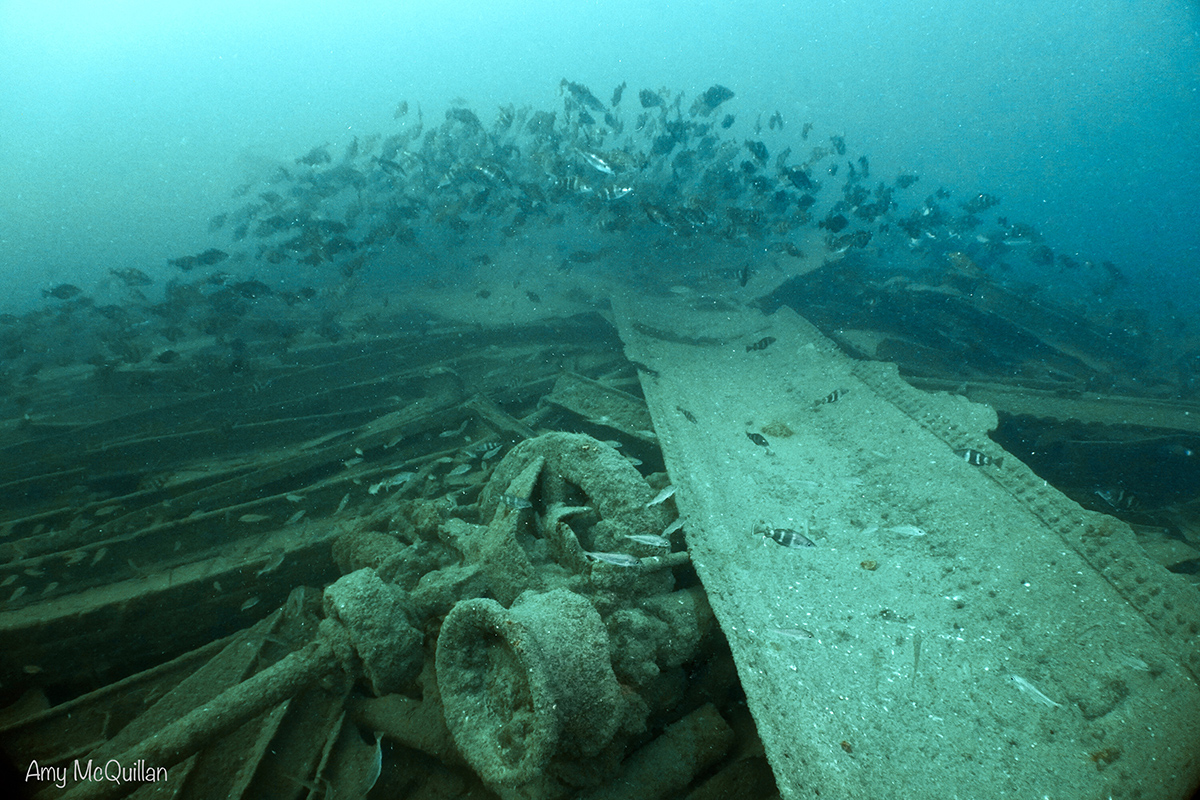
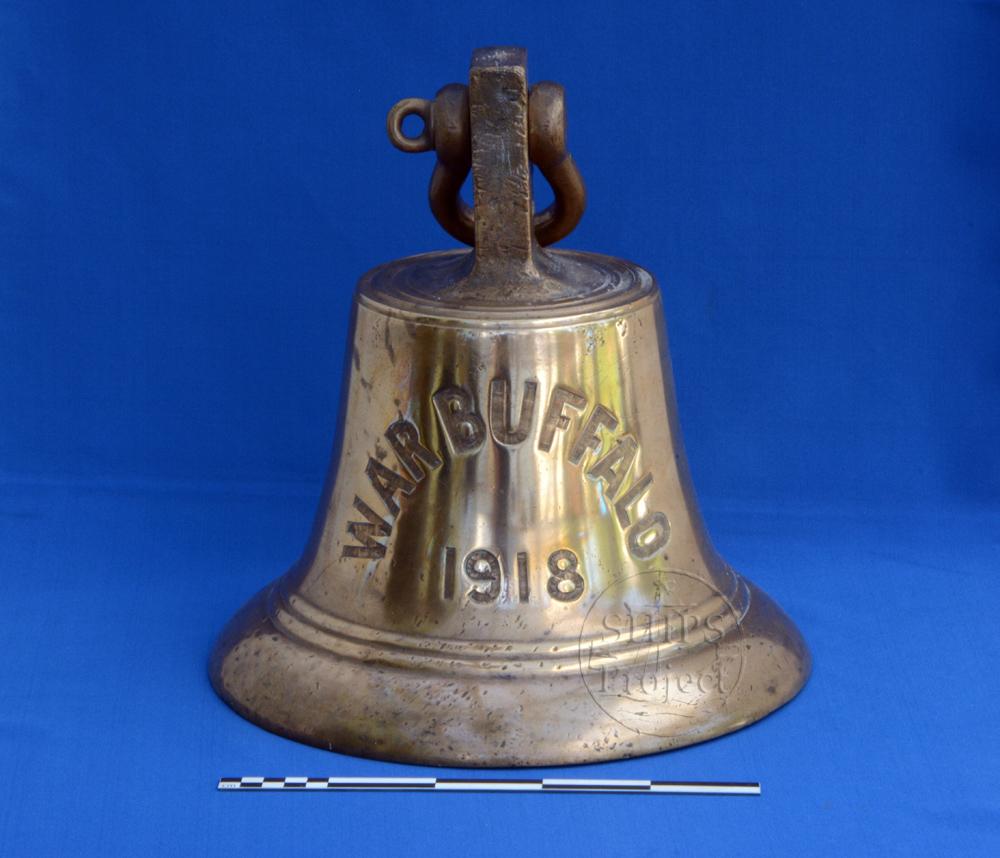
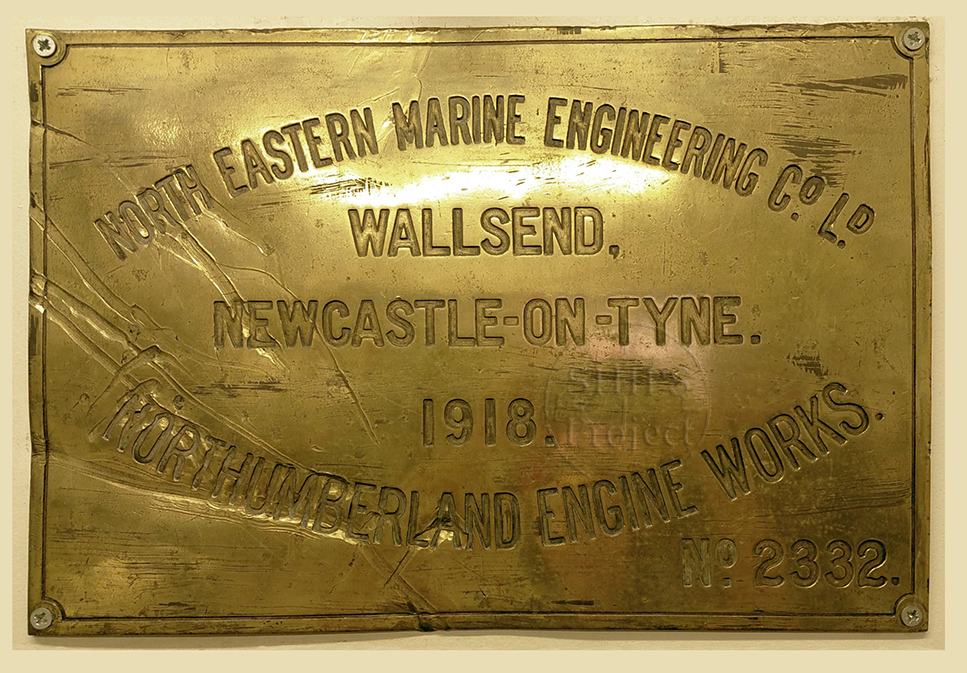
Image use policy
Our images can be used under a CC attribution non-commercial licence (unless stated otherwise).