
History 3: Loss of the A7
This is a condensed version of the story, the full tale of the loss of HM Submarine A7 can be found in the Project Report.
At 8 a.m. on the 16th January 1914, the A7 proceeded to sea with the 25 year old Cornishman Lt. Wellman in command, in company with the depot ship HMS Onyx, the tender Pygmy and five other submarines.
Once in Whitsand Bay the submarines ran a series of dummy attacks against the surface ships. At 11:10 the Pygmy started her next run in front of A7 and the submarine dived to attack. Nothing more was seen of the A7 so Pygmy sailed back towards where the submarine was last seen but there was no sign of her.
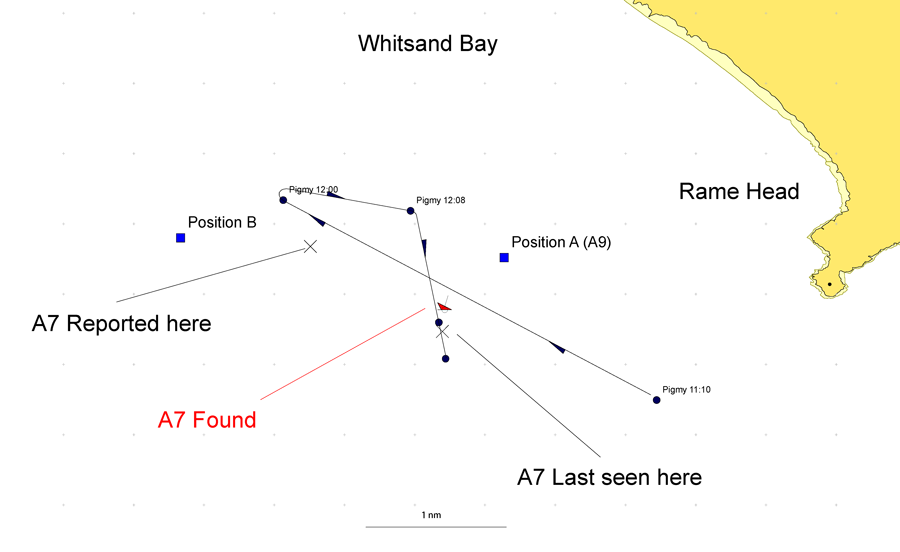
Chart showing Pigmy's track, the last known location of A7, the reported location of A7 and where she was eventually found
At 12:15 one of the crew of Pygmy saw a disturbance on the sea surface and at 12:18 they saw an other up-rush of bubbles suggesting that the crew of A7 were attempting to blow water from her ballast tanks in a desperate attempt to surface. The location was marked with buoy then Pygmy returned to Devonport to report the A7 missing. The crew only had enough air in the submarine for six hours so time was critical. The tug Escort was immediately sent out with two lighters and six divers followed by other tugs and destroyers, with Rear Admiral Murray, Superintendent of the Dockyard, in charge of the salvage operation. A message was sent to Sheerness requesting that Yard Craft No 94 be sent to assist as she had been successful in raising the submarine C14 from Plymouth Sound in the previous December. Unfortunately, by the time the tugs arrived at the place where the A7 sank the buoy dropped by Pygmy could not be found so the rescue ships had no clue about the location of the sunken submarine.
By this time there was no hope for the crew but it was essential that the A7 was salvaged to see what went wrong. Twelve torpedo boats and destroyers were engaged in searching for the submarine using wire sweeps, supported by divers to identify any objects detected on the seabed. Two days after the sinking the ships were reported to be searching in 40 to 48m water depth, deeper than naval divers were expected to work at that time and although they did not know it, a long way to the south of the location where she was finally to be found.
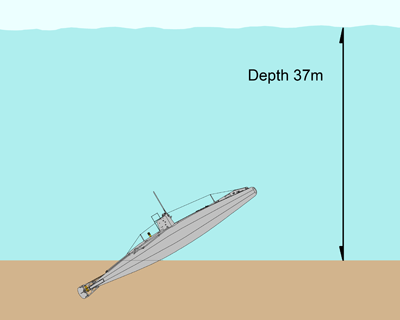
The A7submarine, found with her stern buried in the seabed
By Tuesday 20th there were sixteen ships working in pairs sweeping the seabed with wire hawsers, trying to snag the submarine, but they were hampered by fog, bitterly cold winds and rising seas. Each snag had to be investigated by a diver and so far the only thing they had caught were large rocks. By now Yard Craft No 94 had arrived in Plymouth from Sheerness but she could do nothing to help until the submarine had been found. On Wednesday 21st the commander of the torpedo boat flotilla searching for the A7, Cdr. D.W. Gordon-Hamilton, was found dead in his bunk on board the destroyer Thrasher. It was thought that his death was brought on by standing on the open bridge of his ship for most of the previous day in the bitterly cold weather. Two more snags had been found the evening before and as it was too late for divers to work the snags were marked with buoys and a destroyer anchored by each one.
Diving operations resumed in the morning but to everyone’s disappointment the snags were both found to be rocks. In fact it took many days of searching before the submarine was discovered as the area they had to search was very large. One of the ideas proposed was that the crew had been disabled and submarine had continued heading seaward until she ran out of battery power so the Admiralty stated that they would sweep the entire bay from Rame Head to Looe Island. Finally, on Thursday 22nd, the submarine was found. The crew of the Pygmy, the vessel involved in the original training exercise, spotted a large quantity of oil floating on the sea, they sent down a diver who soon confirmed that they had finally found the A7 only a short distance from where the Pygmy had last seen her.
The wreck was found in 37m depth with between six and seven metres of the submarine’s stern buried in the muddy seabed and the bow 10m off the bottom, raised at an angle of 30°. Attempts were made to move the firmly embedded submarine but bad weather and a heavy swell hampered operations causing the wire hawsers passed under the hull to slip.
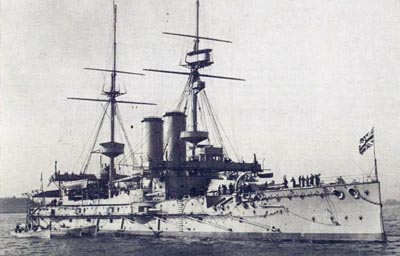
The battleship HMS Exmouth
Capstans on the 14,000 ton battleship HMS Exmouth were used to try and pull the submarine free with a 5.5 inch hawser attached to the sub’s forward lifting eye, but this just fractured the eye plate on the submarine’s bow. Bad weather delayed salvage operation for weeks at a time. But by 25th February the salvage divers from Sheerness under Lt. Highfield had managed to get a hawser around the submarine in the hope that Exmouth could again try and pull her free of the seabed by pulling first to one side and then the other, assisted by detonating underwater charges to help shake her free. The divers hooked up the Exmouth to the hawser and she pulled for an hour and a half until the cable snapped; divers then reported that this had no effect and the submarine still had not moved. By the end of February all attempts to move the submarine had failed and on March 3rd the Admiralty ordered that the recovery operation was to be abandoned.
This was the latest in the long line of A-Class submarines sunk in peacetime during the previous decade and this, combined with the unsuccessful attempts at salvage exposed the Navy to widespread criticism. Questions in the House of Commons suggested that this class of submarines was obsolete as well as dangerous, as did a letter in the Times newspaper from the father of Sub Lt. Morrison who lost his life in the accident.
The King, the Kaiser and Admiral Tirpitz sent their condolences for the loss of the crew. On the 5th March, a flotilla of three battleships, three destroyers and 13 submarines left Devonport led by the cruiser HMS Forth, the parent ship for the Devonport submarine flotilla. The colours on all the ships in the harbour were at half mast as the ships passed by, heading for Rame Head for a memorial service over the wreck site for the lost crew of the A7. A salute was fired, the last post played and when the Forth passed over the place where A7 lay the orphaned son of Engineer Artificer Nagle dropped a wreath of flowers on to the sea.
The full story of the loss of HM Submarine A7 can be found in the Project Report.
Submarine losses 1904-1914
1904 March 18, A1 sunk by a liner off the Isle of Wight, 11 lost
1904 June 20, Russian Delphin sunk at Cronstadt, 26 lost
1905 Feb 16, Gasoline explosion on the A5, 6 killed and 8 injured
1905 June 8, A8 sank in Plymouth Sound, 15 lost
1905 July 6, French Farfadet foundered, 14 lost
1905 Oct 16, A4 sunk in Portsmouth Harbour, no lives lost
1907 June 13, Explosion on the C8, officer killed and 2 injured
1909 April 16, Italian Foca sunk, 13 lost
1909 June 12, Russian Kumbala sunk, 20 lost
1909 July 14, C11 run down by a steamer in the North Sea, 13 lost
1910 April 15, Japanese No. 6 disappeared, 6 lost
1910 May 26, French Pluviôse run down, 27 lost
1911 Jan 17, German U3 sunk off Kiel, 3 lost, 25 rescued by crane
1912 Feb 2, A3 run down by HMS Hazard off the Isle of Wight, 13 lost
1912 June 8, French Vendémiaire sunk, 14 lost
1912 Oct 4, B2 cut in two by the liner Amerika off Dover, 15 lost
1913 June 7, E5 had an explosion in her engine room, one killed, four seriously injured
1913 Dec 10, C14 sunk in Plymouth Sound after collision, no lives lost
1914 Jan 16, A7 sunk in Whitsand Bay
